Listening exercise – 15 basic words
Learn Brazilian Portuguese online! With this simple exercise you are going to improve your listening.
How to say colors in Portuguese

Learn how to say colors in Brazilian Portuguese.
Estória: José e Rute
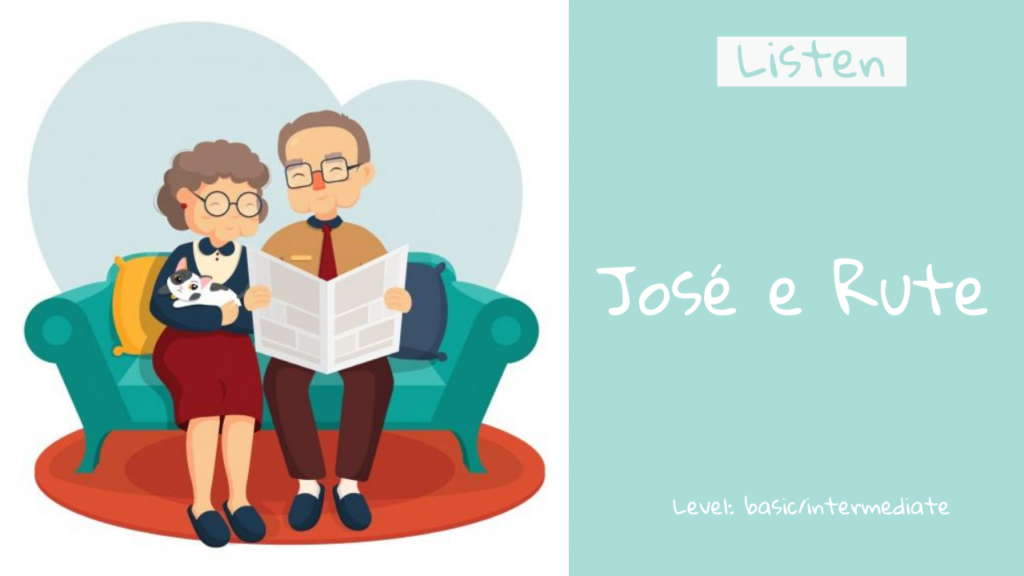
Improve your listening skills with the story of Joseph and Ruth! Below the video you will find the transcription, vocabulary, translation and a short exercise. I hope you enjoy it! Um abraço! Roberta https://youtu.be/5c1oWbEiCUo Transcrição José e Rute são casados há mais de quarenta anos. Eles moram em uma pequena casinha no interior do Rio de Janeiro. A vida deles é bem tranquila. José é um vendedor aposentado. Rute é “do lar” (profissão que nunca aposenta…rss). Todos dos dias eles se sentam em seu sofá verde para ler as notícias do jornal e ficarem informados sobre o que está acontecendo no mundo. Mas a notícia que eles realmente gostam de receber é a de que seus netinhos estão vindo visitá-los. Eles têm uma gatinha malhada. Seu nome é Fifi. Um dia, quando chegaram das compras no mercado encontraram Fifi sozinha, abandonada em seu portão, e resolveram adotá-la. Nos primeiros dias Chel, o cachorro deles, ficou um pouco enciumado. Mas com o passar do tempo acabou virando amigo de Fifi. E agora os quatro vivem em harmonia. Vocabulário *Interior: countryside *Tranquila: quiet *Aposentado: retired *”Do lar” (dona de casa): housewife *Abandonada: abandoned *Enciumado: jealous Translation José and Ruth have been married for over forty years. They live in a small house in the countryside of Rio de Janeiro. Their life is very peaceful. José is a retired salesman. Ruth is housewife (profession that never retires … rss). Every day they sit on their green sofa to read the news from the newspaper and stay informed about what is happening in the world. But the news that they really like to receive is that their grandchildren are coming to visit them. They have a spotted kitten. His name is Fifi. One day, when they arrived from shopping at the market, they found Fifi alone, abandoned at her gate, and decided to adopt her. In the early days Chel, their dog, was a little jealous. But over time he ended up becoming friend of Fifi. And now the four live in harmony. Share this post Portuguese Free Trial Class Pronunciation Listening Grammar Culture Tips Yes, I want! Learn More Brazilian Portuguese Free Trial class Fill out the form with your best email and schedule a free trial class! Facebook Youtube Instagram
How to say numbers in Portuguese
Table of Contents Are in doubt about how to say the numbers in Portuguese? In this article you will learn not only how to speak the numbers in Portuguese, but also how to write them. Portuguese Free trial class Get in touch Numbers in Portuguese: 1 to 10 From 11 to 20 in Portuguese Portuguese Free trial class If You Want A Free Trial Portuguese Class Fill Out The Form with your best email. From 21 to 30 in Portuguese Portuguese for beginners Free trial class Know more Dozens Hundreds Attention: The number “cem” becomes “cento” from the first number added: Example: Thousands: Million – Billion The “e” rules in numbers: But after all, when do we use the “e”? How do you spell the number correctly? We will now learn the “e” rules. Rule 1: Rule 2: Rule 3: Challenge – tell how these numbers are spoken in Portuguese: 3 – 30 – 33 12 – 94 – 115 221 – 710 – 2020 Click on the numbers to see how they are written: 3 Três 30 Trinta 33 Trinta e três 12 Doze 94 Noventa e quatro 115 Cento e quinze 221 Duzentos e vinte e um 710 Setecentos e dez 2020 Dois mil e vinte Portuguese Class Portuguese Free trial class Looking for an effective method to learn Brazilian Portuguese? Click here and enjoy our free trial class. Learn grammar, improve your listening skill and expand your vocabulary. Start now! Pronunciation – listening – Grammar – Culture – Tips Share This Post Receive Portuguese tips by email Get updates and learn from the best Portuguese Free Trial Class Pronunciation Listening Grammar Culture Tips Yes, I want! Learn More Brazilian Portuguese Free Trial class Fill out the form with your best email and schedule a free trial class! Facebook Youtube Instagram
How to say hello in Portuguese

Table of Contents WAYHOMESTUDIO There are different ways to say hello in Portuguese and greet someone. But many people don’t know many of these manners and only know some basic formal greetings. In this article I will help you expand your Portuguese vocabulary, explaining and giving practical examples of how Brazilians use these greetings in their daily lives. It was created from the transcript of the video “how to say hello in Portuguese” that you can watch here or in my YouTube channel @brazilianfriend. I hope this article will help you learn a little more Portuguese today! Portuguese Free trial class Get in touch https://youtu.be/zwcwrykAETw How to say hello in portuguese correctly In Portuguese “hello” literally means “Olá!”. “Olá!” – Pay attention to pronunciation! We don’t speak Spanish like “hola”. In Spanish the strongest pronunciation is “ho”. “Hola”. In Portuguese it is not written in the same way, it is “O – L – A”, and the stressed syllable is in “la”, it is in the last part: Olá! OK? – Olá! That’s how we talk! oi! Another very common way to greet someone in Portuguese is to say “oi”( “hi”). Usually this “oi” is accompanied by “tudo bem?” (“how are you?”): – Oi, tudo bem? (Hi, how are you?) That’s how we speak normally. If someone asks you, “- oi, tudo bem?” The right way to respond is: “tudo bem! (it’s okay!)”. – Oi, tudo bem? (Hi, how are you?) – Tudo bem, e você? (Fine and you?) Portuguese Free trial class If You Want A Free Trial Portuguese Class Fill Out The Form with your best email. E aí? I am from Rio de Janeiro and another greeting that is very common here in Rio de Janeiro is to just say “e aí?” (“what’s up?”) – E aí! Beleza? Beleza? BEAUTY: the word “beleza” literally means “beauty”. But when we speak in that way it is used as slang. It is as if to say: “está tudo bem?” “tá tudo beleza com você?”, “tá tudo bem?” (“are you all right?”) . It is not used in its literal sense. So you also say: – E aí, beleza? (what’s up, all right?). Try talking to your Brazilian friends like this: “e aí, beleza?”. I’m sure they will like it. Portuguese for beginners Free trial class Know more E aê? There is also a little variation in this “e aí?”. Some people say “e aê?” [or just] “aê?” Maybe it can be something only here in Rio de Janeiro. Brazil is very large and has several accents. It is very varied. I think this is a thing here in Rio de Janeiro saying “aê?”. Well, but it could be that you are traveling and find someone who will talk to you like this … “e aí?”. It can also be: “e aí, beleza?” or “e aê?”. Qual é? There is also the “qual é? [coé?] ”: – Qual é, beleza? E aí? It’s a very informal way of asking you, “oi, tudo bem?” (Hi, how are you?) Let’s learn the expressions, right. Because It’s boring just saying… “oi, tudo bem? Tudo bem!… Oi tudo bem? Tudo bem…” all the time. It’s boring! Let’s vary! Let’s learn more Portuguese! Alô! Another way of speaking is also “alô! (hello!). It is usually used on the phone, right “hello”. But sometimes people even say “ah, manda um alô para fulano de tal” (oh, say hello to such people …)”, “manda um alô…” (say hello…). This is what they are saying “say hi to that person”. Fala! Do you already know the verb “falar” (speak)? Well, sometimes here in Brazil we also use “fala” as a compliment: – Fala! – Fala aê! E aí? It is usually: – Fala! – Fala aí, beleza? Have you ever used that expression? Try using it with your Brazilian friends! And how to use that expression? There are different ways to use this expression. Even if the person greeted you in a more formal way, you can use it to respond to that person. For example: – Oi, tudo bem? – Fala aí, beleza? Wow! You will sound very Brazilian! It will be super funny! Variations of “tudo bem?” And to vary the “tudo bem?” (how are you?), “Oi, tudo bem?” you can ask “beleza?”. “Beleza?” it’s a variation of “tudo bem? You can also ask: “e aí, tudo certo?” or “tudo certinho?“. You know that Brazilians we love to say things in the diminutive. “Tudo certo?”(Everything okay?), and its diminutive is “tudo certinho?”: – Tudo certinho? (Are you all right?) – Tudo certinho, graças a Deus! (all right, thank God!) Formal greetings So guys, I spoke more informal things here. How do we really talk in our day to day. And now I’m going to do a review on the formal. As is the formal when we talk about greetings, right. As we say our ‘hello in Portuguese’: – Oi, tudo bem? (Hi, how are you?) – Tudo bem (Okay) – Como você está? (how are you?) – Ah, eu estou bem, graças a Deus! (oh, I’m fine, thank God!) To learn more Do you want to learn even more Portuguese? Come and take Portuguese classes online with me! You can be getting in touch through Instagram: @brazilianfriend, or through my website in the contacts area, or simply by sending an email to: robrazilianfriend@gmail.com. With my classes I can help you who are really beginners in Portuguese, or who already speak Portuguese, but want to improve your pronunciation, I prepared an exclusive content to help you on this journey of learning Brazilian Portuguese. With me you will speak Portuguese from day one. My focus is informal Portuguese. Learn how Brazilians really speak. So come and talk to me, get in touch and “let’s go” to study Portuguese! See you! Summary Obviously You can just use the basic words you may already know, like “hi” and “how are you?” But how about trying some of the new words you learned from this
How to pronounce the Portuguese alphabet

Table of Contents Have you decided to learn Portuguese, but you are still a beginner and don’t know what the Brazilian alphabet sounds like?Then this article is for you. In it you will find explanatory videos and audios, as well as tips on the Brazilian alphabet and how I can help you start learning Brazilian Portuguese for free. Portuguese Free trial class Get in touch Brazilian Portuguese Alphabet Well, before I start I have two important warnings to make: First of all, I’m from Rio de Janeiro, so I have a traditional accent here in Rio de Janeiro. Brazil is very big and we have different accents. And maybe you’ll hear a letter with a slightly different pronunciation than you might have seen in another video, ok? Secondly, the letters “k” “w” and “y” traditionally are not part of our alphabet. They were incorporated later. And so they are used only for: proper names (Wagner), words of foreign origin (Milkshake, Show!) And units of measures (km = kilometer, Kg = kilogram, W = watt). If possible always try to repeat the letters aloud because speaking is important when learning a new language. So let’s go! Improve your pronunciation Now I’m going to speak each letter again giving examples of words that start with that letter. Try to repeat each letter and word again, as this will help to improve your pronunciation and also expand your vocabulary. A – abelha B – bola C – coração D – doce E – estrela F – família G – gato H – hospital I – igreja J – jovens K – kiwi L – laranja M – mão N – nariz O – orelha P – peixe Q – quadro R – régua S – sapato T – tesoura U – urso V – vaca W – Wagner X – xadrez Y – yakisoba Z – zebra Portuguese Free trial class If You Want A Free Trial Portuguese Class Fill Out The Form with your best email. Exercise Tell me how to speak these letters in Portuguese! [A – G – E – Y – J – P – B – O – M – W – V- P] So, did you get any letters right? If not, don’t be sad, watch the video again and do the exercise again! Portuguese for beginners Free trial class Know more Reach your goals with Portuguese Language I teach Portuguese online for foreigners. And I can help you Reach your goals with Portuguese Language. Contact me and see if I have time availability. I have prepared exclusive content for you who want to learn Portuguese, even if you are a beginner. Get in touch and let’s schedule your class! Follow me on Instagram: @brazilianfriend. You can send me a message, send your questions, get in touch with me. There I am always posting new content, especially for you who are starting to learn Portuguese. And if you want even more content visit my website: www.brazilianfriend.com and check out the news. Portuguese Class Portuguese Free trial class Looking for an effective method to learn Brazilian Portuguese? Click here and enjoy our free trial class. Learn grammar, improve your listening skill and expand your vocabulary. Start now! Pronunciation – listening – Grammar – Culture – Tips Share This Post Receive Portuguese tips by email Get updates and learn from the best Portuguese Free Trial Class Pronunciation Listening Grammar Culture Tips Yes, I want! Learn More Brazilian Portuguese Free Trial class Fill out the form with your best email and schedule a free trial class! Facebook Youtube Instagram